+86 157 3199 9797

+86 157 3199 9797
Oct. 30, 2026
Heavy trucks, buses, and trailers brake with compressed air rather than hydraulic fluid. Air is plentiful, a leak makes the system lose pressure instead of spilling fluid onto the brakes, and a trailer can be connected simply by coupling two air lines. Most importantly, air brakes are fail-safe: the parking and emergency brakes are applied by powerful springs that are held back by air pressure, so if the pressure is lost, the springs apply the brakes automatically.
A truck air brake system therefore combines three functions: the service brake used while driving, the parking brake, and the emergency brake. Understanding how air travels through the system, and why the air must be clean and dry, explains why the air dryer and its replaceable filter cartridge are such important maintenance items.
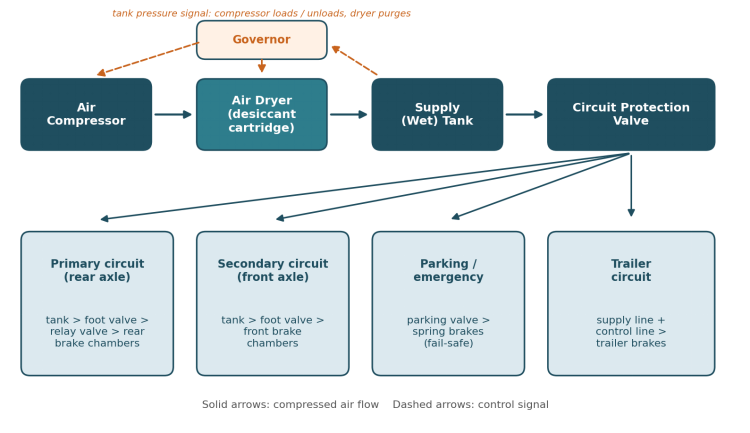
Figure 1. Simplified layout of a truck air brake circuit. Real systems vary by manufacturer and vehicle.
1. Air compressor. Driven by the engine, the compressor pumps air into the system. When the system is fully charged, it stops compressing and idles in an unloaded state.
2. Governor. The governor senses tank pressure. It stops the compressor from loading at the cut-out pressure and lets it resume at the cut-in pressure. The same signal tells the air dryer when to purge.
3. Air dryer. Compressed air leaves the compressor hot and carrying water vapour and a small amount of oil. The air dryer removes both before the air reaches the tanks.
4. Supply (wet) tank. The first reservoir. It collects any remaining moisture and has a drain valve. A safety valve protects the system from over-pressure.
5. Circuit protection valves. These keep the brake circuits separate, so that a failure in one circuit does not drain the others.
6. Service reservoirs. Dual air systems have a primary circuit, typically serving the rear axle, and a secondary circuit, typically serving the front axle, so that braking remains if one fails.
7. Foot brake valve, relay valves, and quick-release valves. The foot valve meters air to the brakes according to pedal travel. Relay valves and quick-release valves speed up application and release.
8. Brake chambers and foundation brakes. Brake chambers turn air pressure into mechanical force that applies drum or disc brakes. Spring brake chambers combine a service chamber with a powerful parking spring.
9. Parking brake and trailer controls. The parking brake valve and the trailer supply valve release the spring brakes when pressure is available, and apply them when it falls. Trailers connect through a supply (emergency) line and a control (service) line.
10. ABS and electronic braking. Modern trucks add ABS or electronic brake control valves, which depend on a steady supply of clean, dry air.
The figures below are commonly quoted US reference values (FMVSS 121 and commercial driver training materials). Other markets and manufacturers use different values and units, often in bar, so always follow the vehicle's manual.
|
Item |
Typical Value |
Approx. Bar |
What It Means |
|
Governor cut-in |
About 100 psi |
6.9 |
Compressor starts loading again |
|
Governor cut-out |
About 125 psi (120 to 140) |
8.6 |
Compressor stops loading, system fully charged |
|
Safety valve |
About 150 psi |
10.3 |
Opens if pressure is too high, indicating a fault |
|
Minimum pressure before driving |
100 psi in both circuits |
6.9 |
Do not move the vehicle below this |
|
Low-pressure warning |
Below 60 psi |
4.1 |
Warning light and buzzer, stop as soon as it is safe |
|
Spring brakes apply |
20 to 45 psi |
1.4 to 3.1 |
Parking brakes apply automatically |
|
Build-up rate |
85 to 100 psi in 45 seconds |
5.9 to 6.9 |
A slow build-up can point to a compressor or governor problem |
|
Leakage (single vehicle) |
2 psi per minute static, 3 psi per minute applied |
0.14 and 0.21 |
Higher leakage means a leak to find and fix |
The compressor produces hot air containing water vapour, and a small amount of oil usually passes the piston rings. As the air cools in the lines and tanks, the water condenses. Left untreated, this moisture and oil cause several problems:
The air dryer exists to stop these problems at the source.
An air dryer works in two alternating cycles that are controlled by the governor.
Charge cycle. While the compressor is loading, hot air enters the dryer and cools. Oil and water droplets are separated, and the air passes through the desiccant, a granular material that adsorbs moisture. Dry air then flows through a check valve into the supply tank. In oil-coalescing cartridges, a coalescing material is placed ahead of the desiccant so that oil and oil aerosols are removed before they can coat it.
Purge cycle. When the governor unloads the compressor, the dryer opens its purge valve. A portion of dry air flows back through the desiccant, regenerating it, and carries the collected moisture and contaminants out through the exhaust.
Heater. Many dryers include a heater and thermostat to stop the purge valve and exhaust from freezing in cold weather.
The desiccant and the oil separator have a limited life, normally around one to three years, because oil from the compressor gradually coats the desiccant beads and keeps them from capturing water. For this reason they are built into a replaceable cartridge, which is the air dryer filter.
|
Type |
Description |
Notes |
|
Standard desiccant cartridge |
Desiccant bed with basic oil filtering |
General use, shorter protection against oil |
|
Oil-coalescing cartridge |
Adds a coalescing stage ahead of the desiccant |
Recommended by some manufacturers for all vehicles; do not swap for a standard cartridge where the system calls for it |
|
Spin-on cartridge |
Screws onto the dryer base |
Most commonly M39x1.5 thread; some DAF applications use M41x1.5 |
|
Cartridge in a housing |
Inserted into the dryer body under a cap |
Check manufacturer's service data for the correct element |
A small amount of moisture or oil at the dryer exhaust can be normal. A heavy amount of oil, however, usually means the compressor is passing oil. In that case a new cartridge will only buy a short time, and the compressor needs attention. Bendix describes a test method called the BASIC test for measuring compressor oil carry-over.
Intervals depend on the dryer, the cartridge, the compressor, and how hard the truck works. The figures below are published guidance from Bendix for its dryers and cartridges, and are a useful benchmark. Always follow the data sheet for your own dryer.
|
Air Usage |
Typical Vehicle |
Check Interval (whichever comes first) |
|
Standard |
Line haul, city delivery |
25,000 miles, 900 hours, or 3 months |
|
Medium |
Double trailers, light transit, light off-highway |
12,000 miles, 450 hours, or 2 months |
|
High |
Multiple trailers, city transit, heavy off-road |
6,000 miles, 300 hours, or 1 month |
|
Operation |
Replacement Guidance |
|
Single-trailer line haul (Bendix compressor) |
Every 3 years or 300,000 miles |
|
Pick-up and delivery, or double and triple trailers |
Every 2 years or 200,000 miles |
|
Severe service such as refuse trucks and school buses |
Every year or 100,000 miles |
|
High or sensitive air demand such as city buses and off-road |
Every 6 to 12 months |
|
Non-Bendix compressors (shorter guidance) |
6 months or 50,000 miles, 1 year or 100,000 miles, or 2 years or 200,000 miles, depending on duty |
|
WABCO cartridge range |
Rated for roughly 1 to 3 years depending on the cartridge type |
Many manufacturers also recommend replacing the purge valve and the check valve at the same time as, or at regular intervals with, the cartridge. Bendix, for example, recommends replacing the delivery check valve at every other cartridge replacement. A fresh cartridge behind a failing purge valve does not solve the problem.
Brake components are safety-critical. These steps are a general outline only. Use the manufacturer's service instructions and, if in doubt, a qualified technician.
The references below appear frequently in catalogs. Part numbers vary by dryer and vehicle, so always verify before ordering.
|
Reference |
Description |
|
Bendix 5008414 |
Desiccant cartridge for AD-IS and AD-SP dryers, listed with Meritor R109994 and Haldex 109994K |
|
Bendix 5008414PG |
Oil-coalescing (PuraGuard-type) cartridge for AD-IS and AD-SP, listed with WABCO R950068A |
|
Haldex 31005609 |
Cartridge listed for Bendix AD-SP and AD-IS and WABCO SS1200 dryers |
|
WABCO 4324102227 |
Cartridge listed with Scania 1932719, MAN 81521020008, and Mercedes-Benz A0004293695 |
|
WABCO 4324100202 |
Cartridge listed with Iveco 970259024, DAF 1527878, Renault 5001860088, and Volvo 20721469 |
|
Volvo 23099526 |
Air dryer cartridge for the SS1200 system |
How often should an air dryer filter be replaced? Manufacturer guidance ranges from about one to three years, or a mileage figure, depending on the dryer, the cartridge, the compressor, and the duty cycle. Severe service, high oil carry-over, and humid climates shorten the interval.
Why is there still water in the tanks after I fitted a new cartridge? Common causes are a failing purge valve or check valve, the wrong cartridge, compressor oil carry-over saturating the new cartridge, or a dryer that is not purging properly. Tank moisture after a recent change is a sign the cause has not been fixed.
Can I use a standard cartridge instead of an oil-coalescing one? Where the system calls for an oil-coalescing cartridge, manufacturers advise against substituting a standard one. Upgrading from a standard to an oil-coalescing cartridge is generally encouraged.
Do all trucks use the same air dryer filter? No. Dryers differ in thread, diameter, height, and type, so the filter must be matched to the dryer and the vehicle.
Is it enough to drain the tanks regularly? Draining helps you check for moisture and removes some water, but it does not replace a working dryer or a fresh cartridge.
ADAOER Filter supplies air dryer filters together with oil, fuel, air, hydraulic, and cabin filters for trucks, buses, and heavy machinery, with cross-reference matching and OEM/ODM service. Send us your dryer model or the old cartridge's part number and we will confirm the match.
Brand names and part numbers are used for identification and compatibility reference only. Bendix, WABCO, Haldex, Knorr-Bremse, Meritor, Volvo, Scania, MAN, Mercedes-Benz, DAF, Iveco, Renault, Cummins, Fleetguard, Donaldson, Mann, Hengst, Baldwin, WIX, Mack, Perkins, Weichai, and Sinotruk are trademarks of their respective owners. ADAOER Filter is an independent manufacturer and is not affiliated with any of them. This article is for general information only and does not replace the vehicle manufacturer's service manual.
How to Find the Right Truck Filter: Part Numbers, Cross-References, and Measurements
Oct. 30, 2026
European Emission Standards (Euro I to Euro VII) and What They Mean for Truck Filters
Oct. 30, 2026
Truck Air Brake System and Air Dryer: How They Work and How to Maintain Them
Oct. 30, 2026
Oct. 27, 2026
Related Products